Testing for a Difference in Means
We can perform a formal hypothesis test to answer questions concerning a difference in two population means.
We’ll use the same steps introduced in our Introduction to Hypothesis Testing notes, but some of the details will differ in this new scenario.
1. Identify the question and parameter of interest.
Motivating Example:
Is there a difference in the average amount of time users spend on the Standard Site vs. the Updated Site?
The parameter of interest:
The difference in the average amount of time spent on the two sites, \(\mu_S - \mu_U\)
2. Set up the null and alternative hypotheses
Null hypothesis
\[H_0: \mu_1 = \mu_2\]
Alternative hypothesis:
This depends on the question of interest.
Lower one-sided
Question of interest: Is the mean of population 1 less than the mean of population 2?
\(H_A: \mu_1 <\mu_2\)
Upper one-sided
Question of interest: Is the mean of population 1 greater than the mean of population 2?
\(H_A: \mu_1 >\mu_2\)
Two-sided
Question of interest: Is the mean of population 1 different from the mean of population 2?
\(H_A: \mu_1 \neq\mu_2\)
2. Set up the null and alternative hypotheses
Motivating Example:
\(H_0:\)\(\mu_S = \mu_U\)
\(H_A:\mu_S \neq \mu_U\)
Practice! 🐓
Answer questions 7-8 on the Class 15 Activity - Difference in Means activity on Canvas.
Leave the activity open. We’ll come back to it.
3. Collect and summarize the data.
Motivating Example:
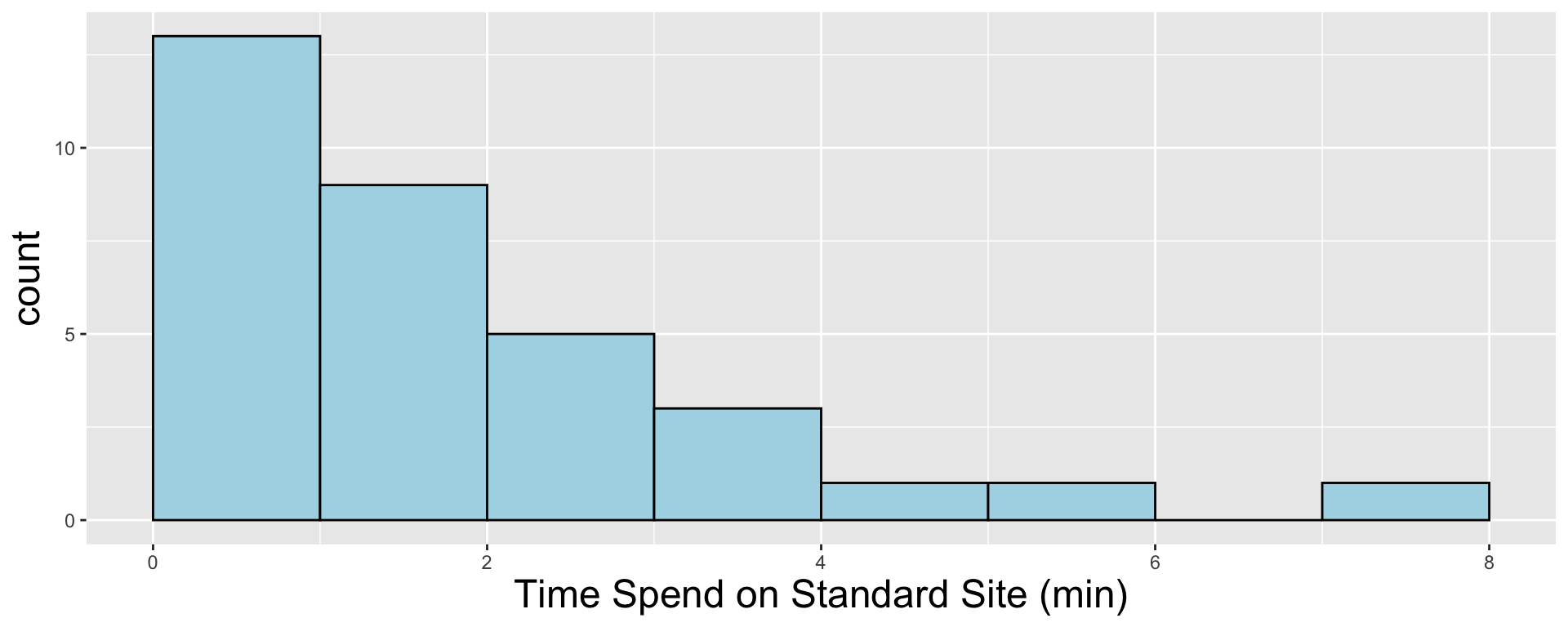
\[\overline{x}_S = 1.77 \text{ min}\] \[ s_S = 1.68 \text{ min}\] \[n_S = 33\]
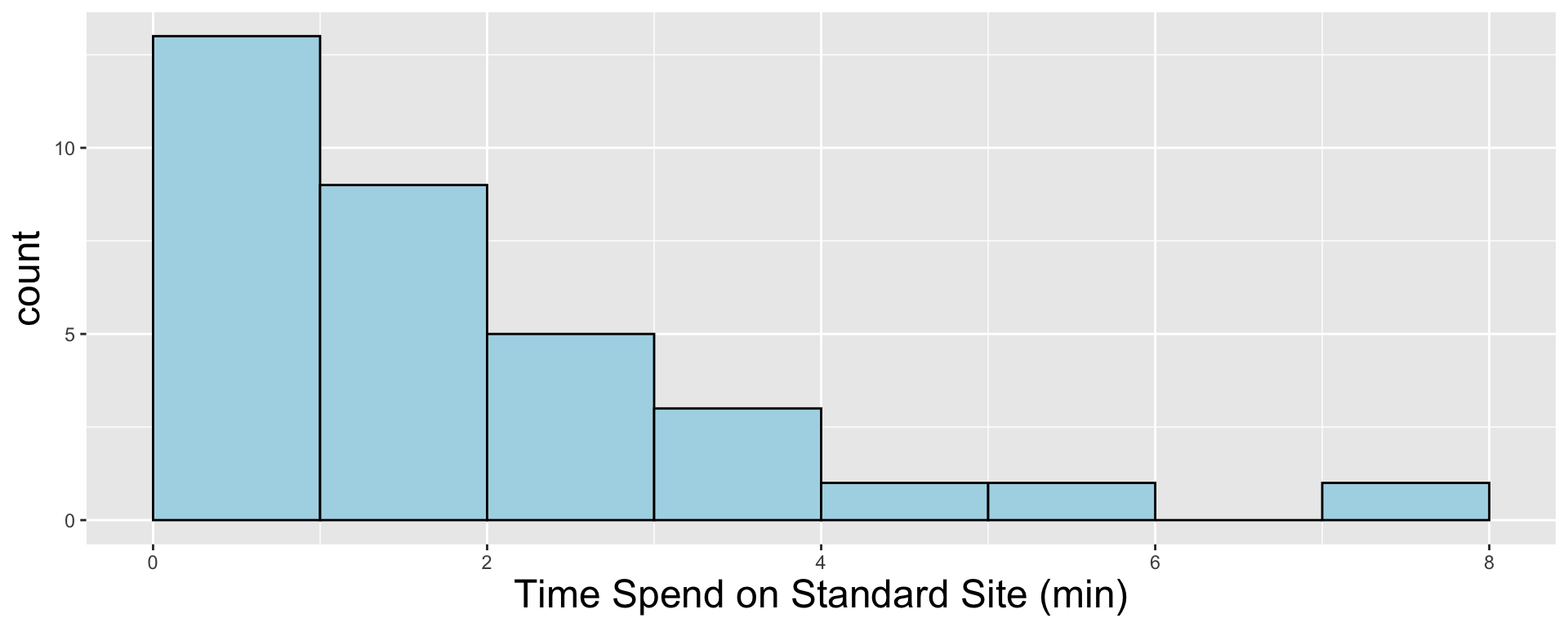
\[\overline{x}_U = 2.22 \text{ min}\] \[s_U = 2.09 \text{ min}\] \[n_U = 32\]
4. Determine the Null Distribution
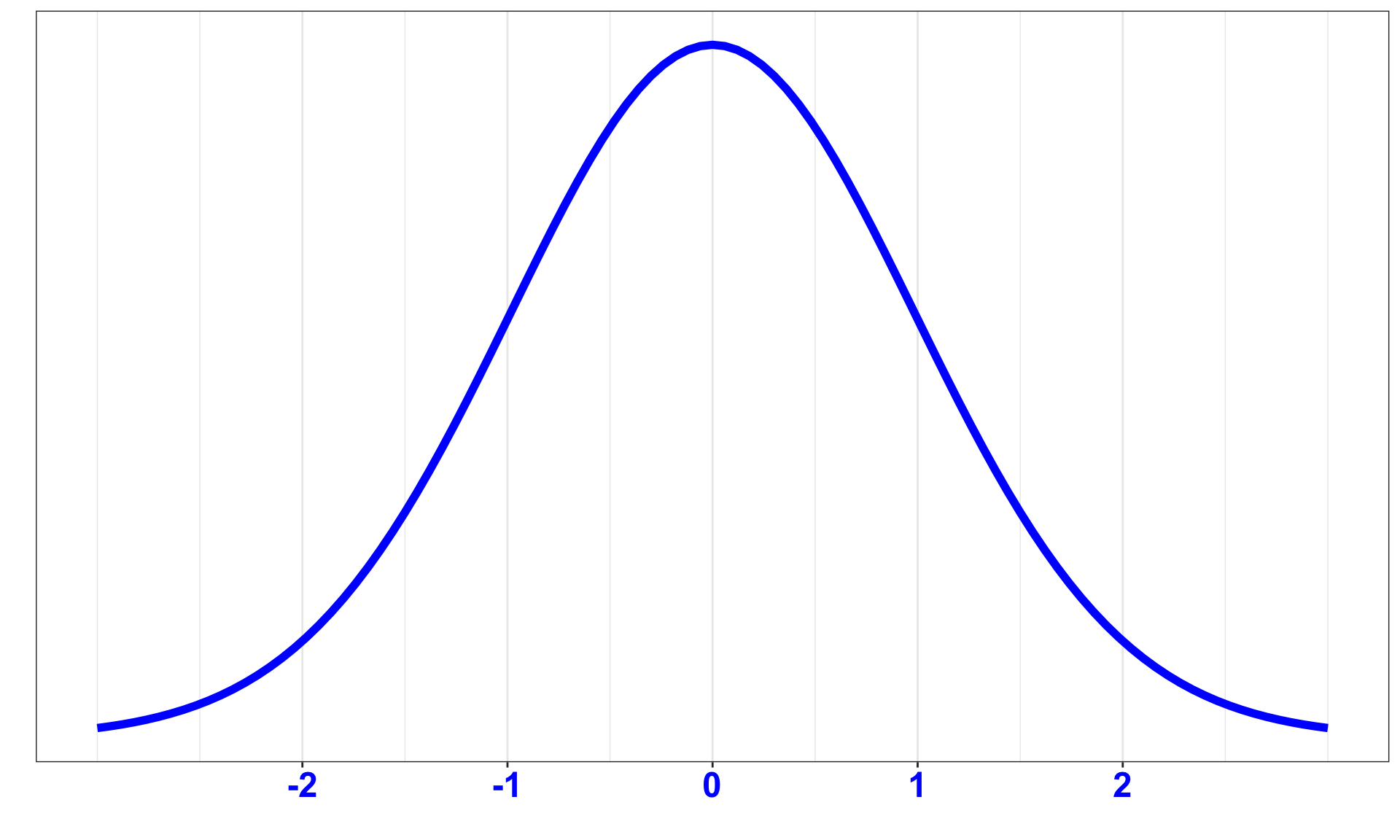
If the sample sizes are sufficiently large, under the null hypothesis, the distribution of the test statistic used in testing the difference between two population means is a
t distribution with \(\nu\) degrees of freedom.
\(\nu\) represents the Satterthwaite degrees of freedom.
How large do the samples need to be?
If both \(n_1\geq 30\) and \(n_2 \geq 30\), we can move forward.
If either \(n_1 < 30\) or \(n_2 < 30\), we need to look at the sampled distribution(s) of the small sample(s). If there are no clear outliers or strong skewness in the sampled data, we can move forward. If either sampled distribution suggests skewness or outliers, we should not proceed.
4. Determine the Null Distribution
Motivating Example:
Are the sample sizes sufficiently large?
Yes, both \(n_1\geq\) and \(n_2\geq30\).
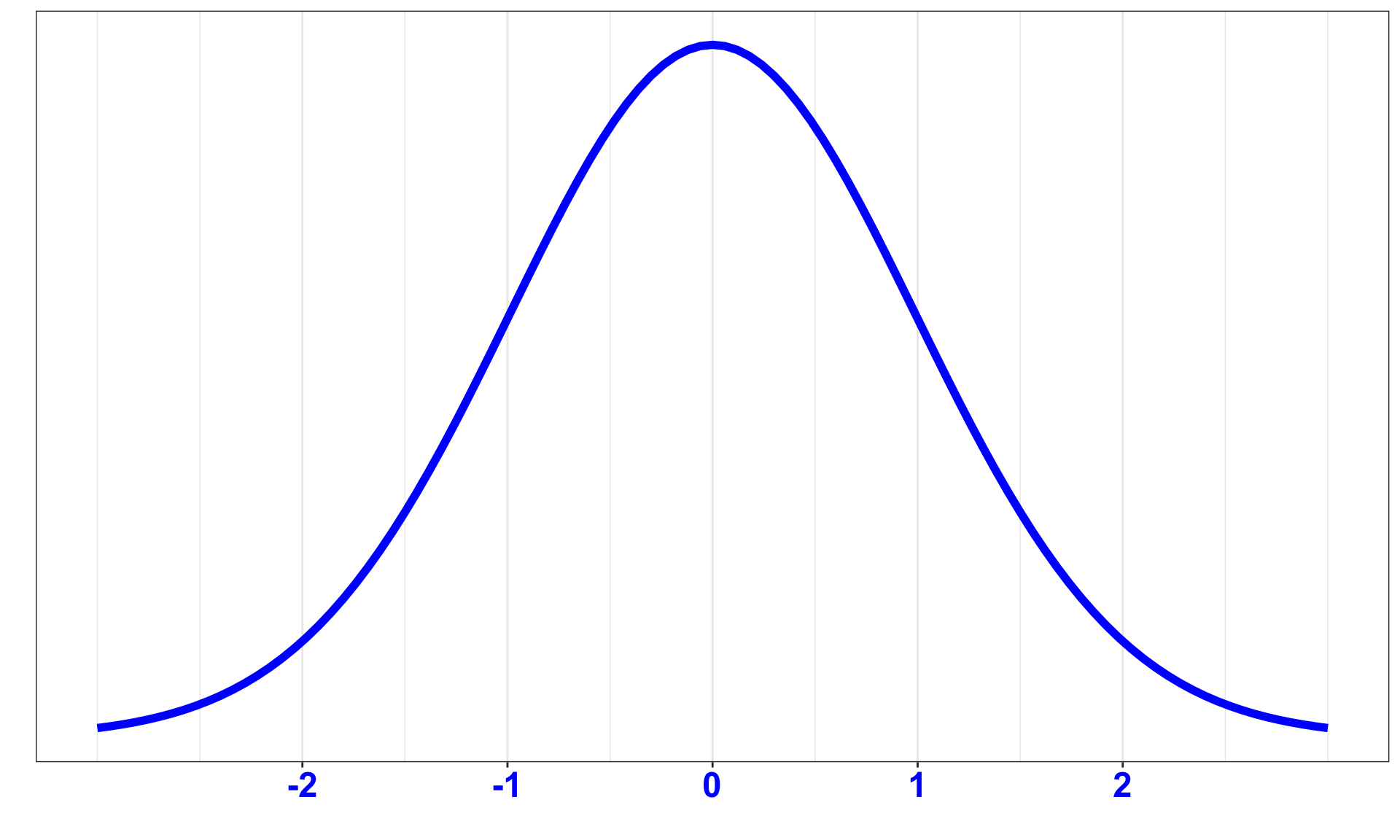
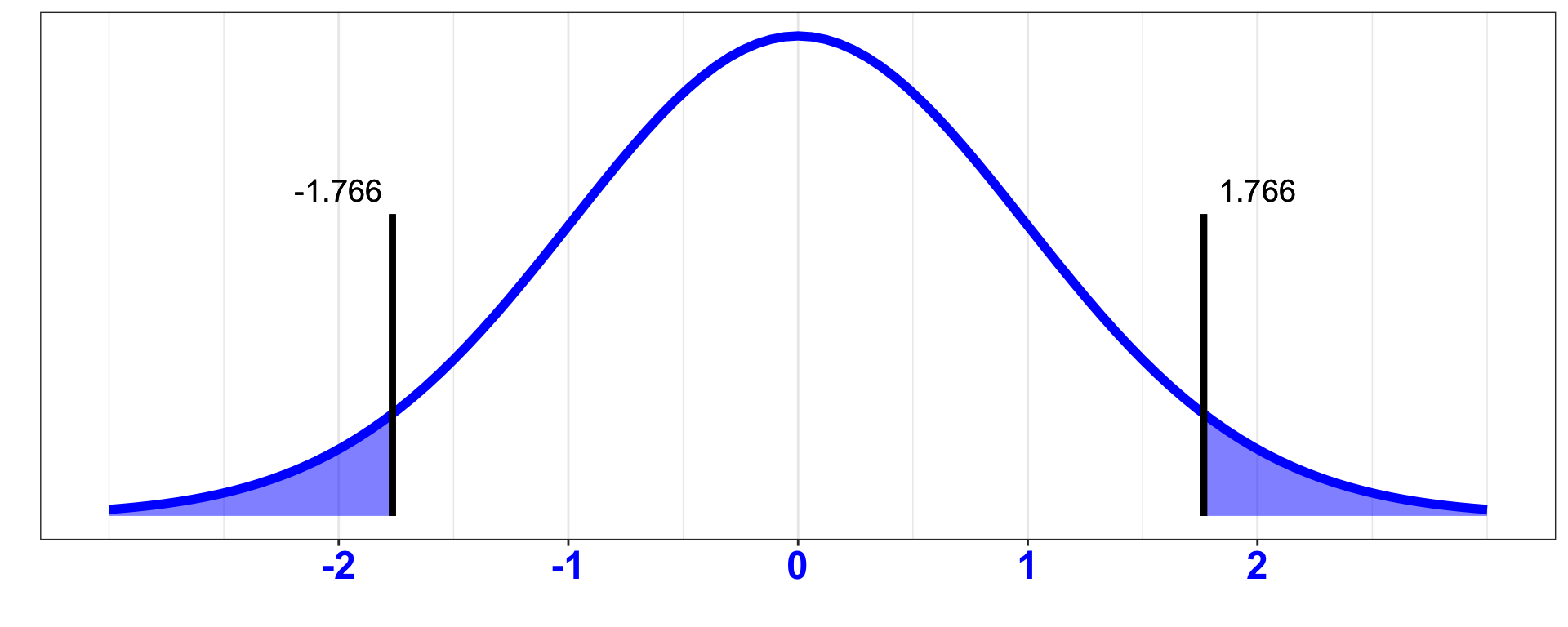
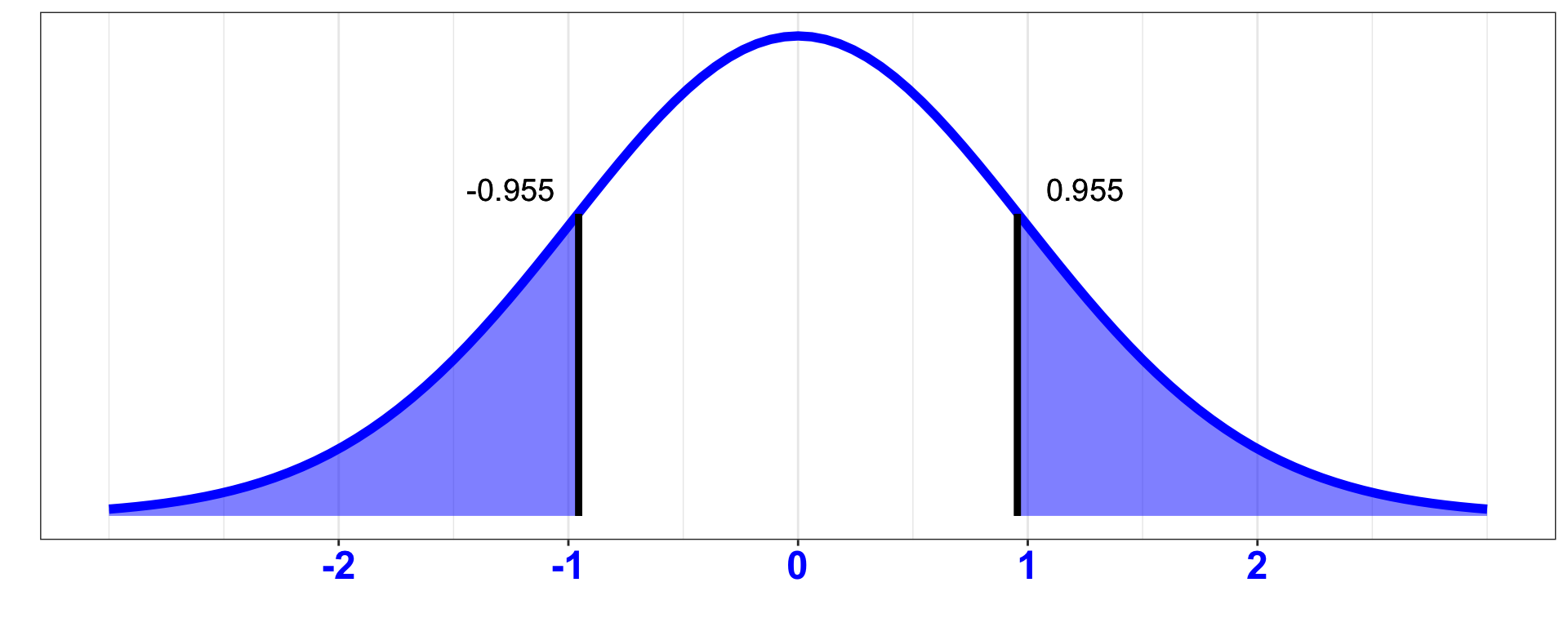
So the null distribution is at distribution with 59.419 degrees of freedom.
5. Calculate the test statistic
When testing the difference in population means, \(\mu_1\) vs. \(\mu_2\), the test statistic is
\[t = \frac{\overline{x}_1-\overline{x}_2}{\sqrt{\frac{s_1^2}{n_1} + \frac{s_2^2}{n_2}}}\]
5. Calculate the test statistic
When testing the difference in population means, \(\mu_1\) vs. \(\mu_2\), the test statistic is
\[t = \frac{\overline{x}_1-\overline{x}_2}{\sqrt{\frac{s_1^2}{n_1} + \frac{s_2^2}{n_2}}}\]
Motivating Example:
\[t = \frac{1.77-2.22}{\sqrt{\frac{1.68^2}{33} + \frac{2.09^2}{32}}} = -0.955\]
6. Calculate the p-value using the test statistic and null distribution.
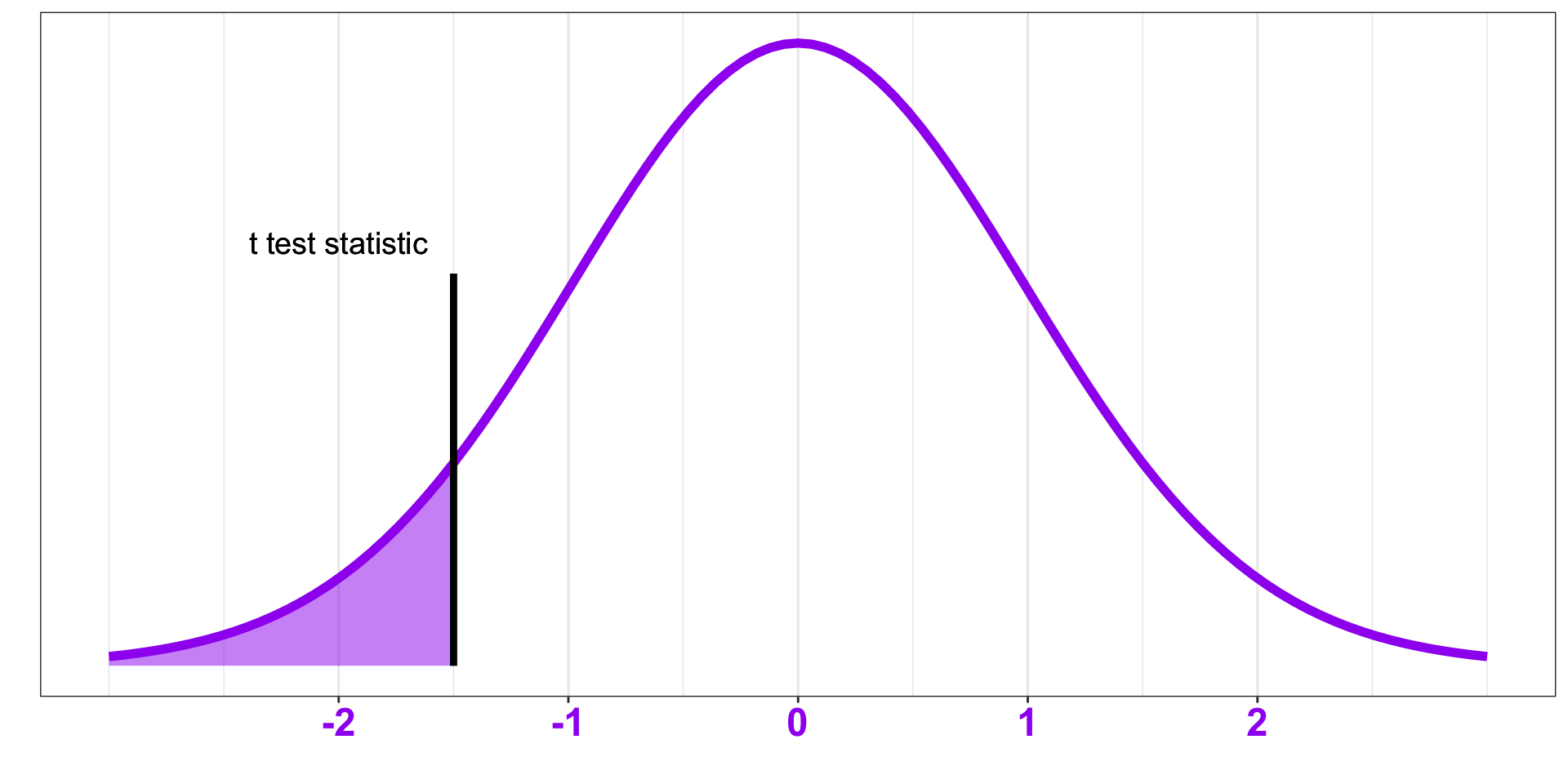
Lower one-sided:
\(H_A: \mu_1<\mu_2\)
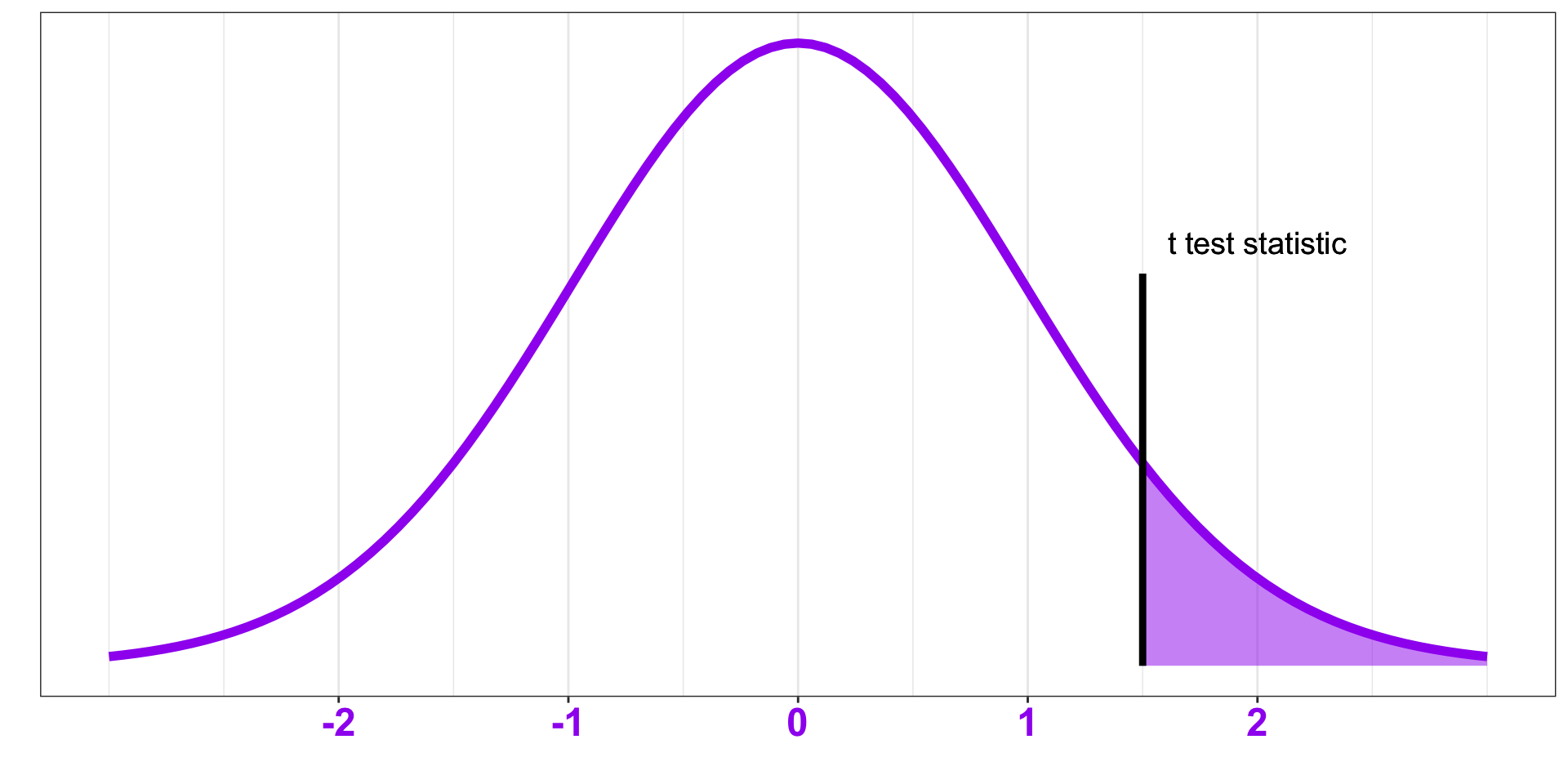
Upper one-sided:
\(H_A: \mu_1>\mu_2\)
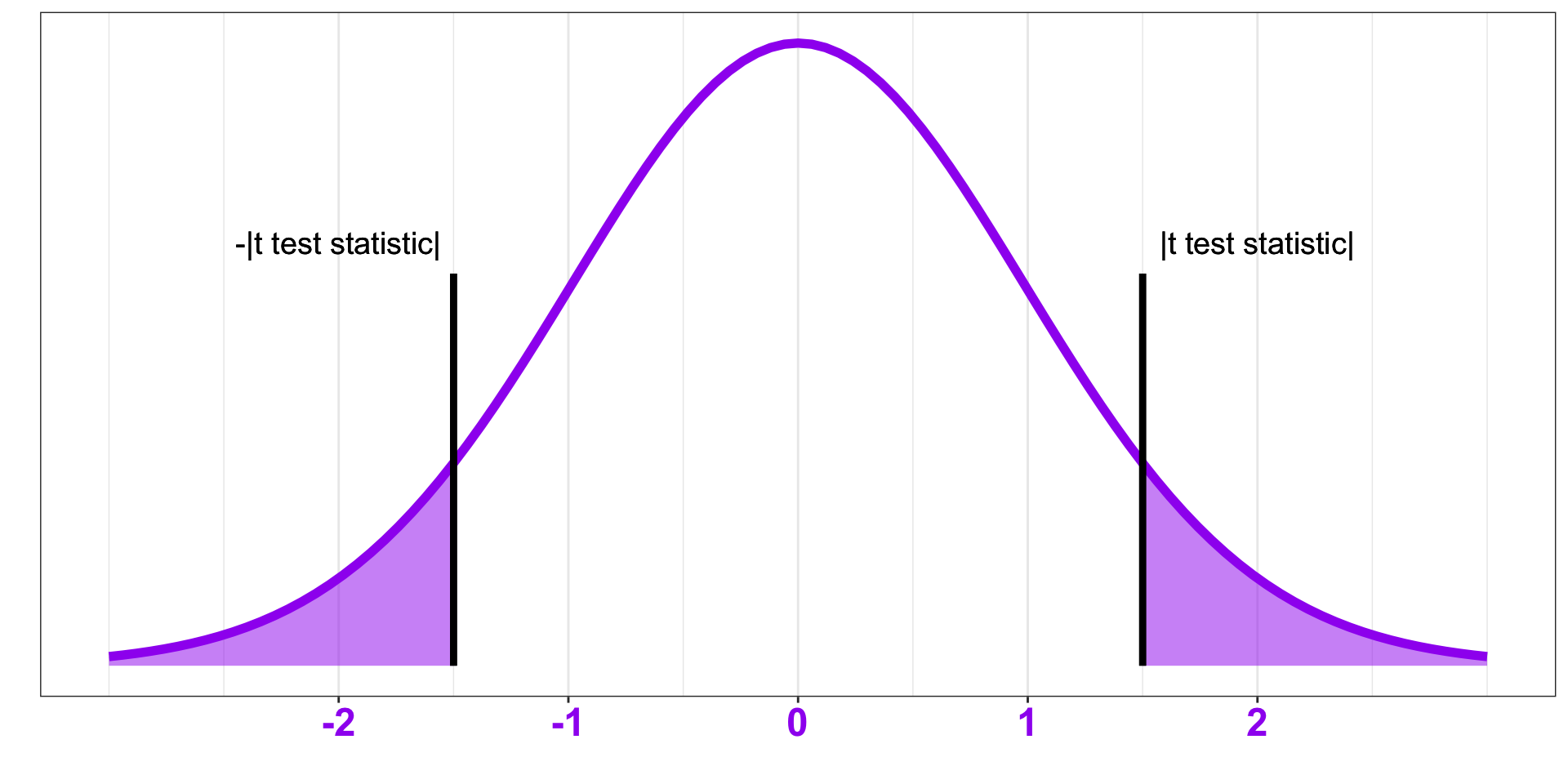
Two-sided:
\(H_A: \mu_1\neq \mu_2\)
R code:
2*(1-pt(abs(t), df))
where df is the Satterthwaite degrees of freedom, \(\nu\)
6. Calculate the p-value using the test statistic and null distribution.
Motivating Example:
2*(1-pt(abs(-0.955), 59.419)) = 0.343
Practice! 🐓
Answer questions 9-11 on the Class 15 Activity - Difference in Means activity on Canvas.
7. Make a conclusion
Write a 4-part conclusion. The conclusion should be written in the context of the problem and contain the following components:
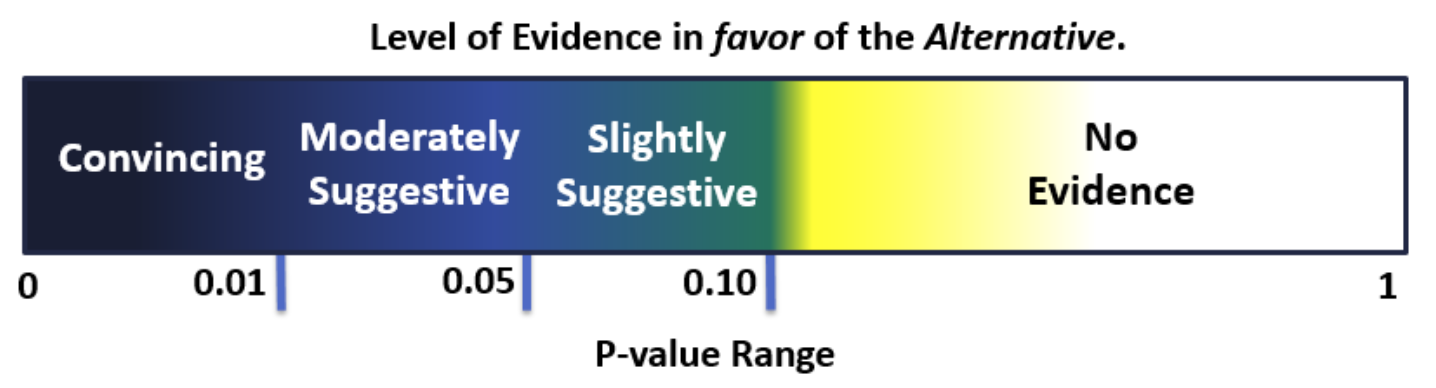
A statement for the strength of evidence in favor the alternative hypothesis.
Whether to reject or fail to reject the null hypothesis.
The point estimate for the parameter of interest.
A \((1-\alpha)100\%\) confidence interval estimate for the parameter of interest.
7. Make a conclusion
A statement in terms of the alternative hypothesis
- Using terms like “reject” and “fail to reject the null” may be confusing to novice readers.
- We’ll provide a more complete conclusion by providing a statement of evidence in terms of the alternative hypothesis that reflects the question of interest.
7. Make a conclusion
Motivating Example: Write a 4-part conclusion with a \(\alpha=0.01\) significance level.
1. There is no evidence that the mean time spent on the Standard Site differs from the mean time spent on the Updated Site.
2. At the \(\alpha=0.01\) significance level, we fail to reject the null hypothesis.
3. and 4. We are 99% confident that the users spend 1.70 minutes less to 0.80 minutes more on the Standard Site than on the Updated Site, on average, with an estimated difference of 0.45 more minutes spent on the Updated Site on average.